
YELLOW NOSE STUDIO ON STAYING FEARLESS
Hsin-Ying Ho and Kai-Ming Tung invite you into their space of childlike curiosity
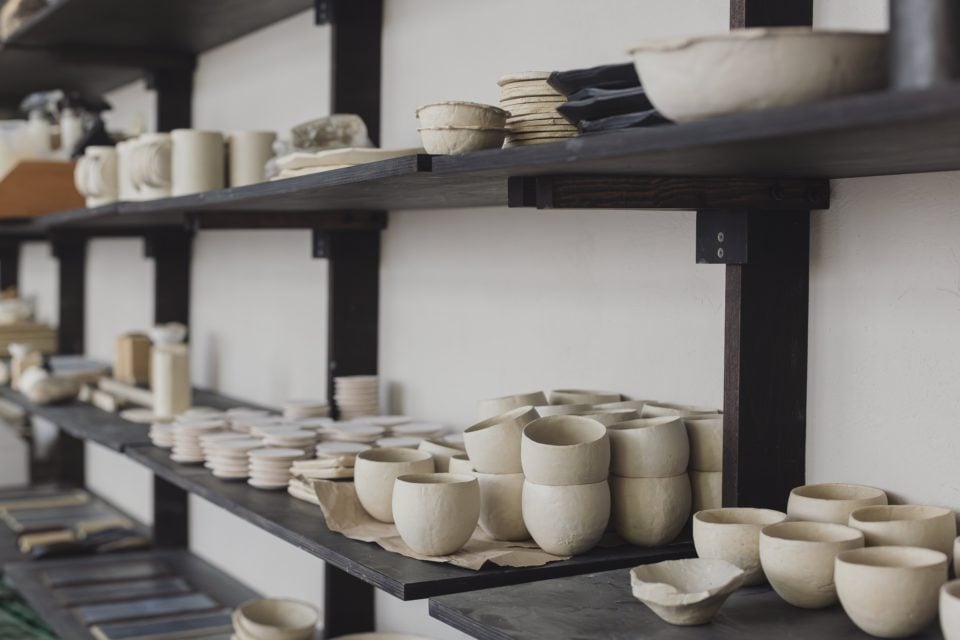
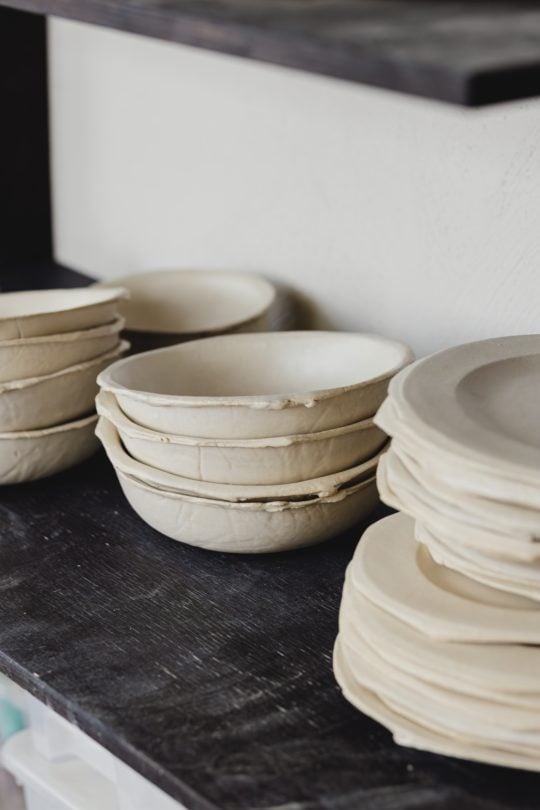
“We create things through living,” Kai says as he hands me a cup of water, while Ying is out getting coffee at the café next door. Their studio seems to echo his words: shelves climb almost to the ceiling, crowded with bowls, cups, plates, and vases. Some are glazed in soft whites or smoky greys, others left in the warm, sandy rawness of clay. On the adjacent wall, hammers, tongs, scissors, and other tools hang neatly in place, and in the corner, the kiln waits for its next firing.
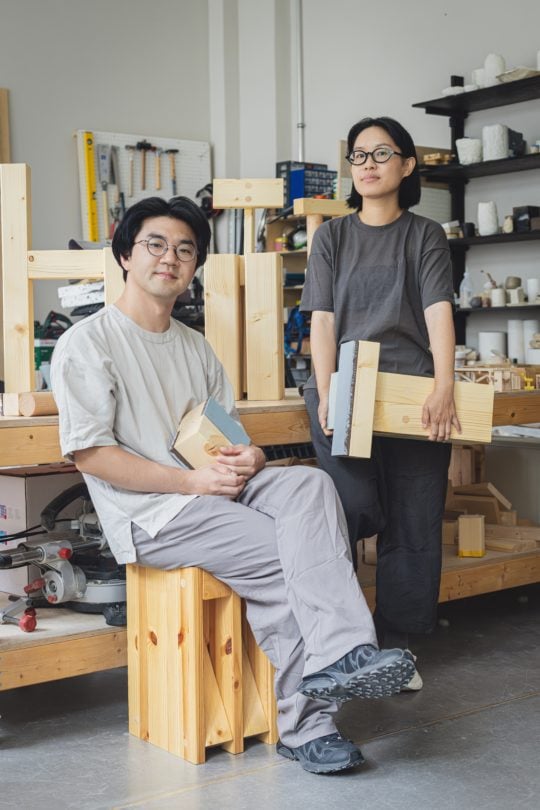
Taiwanese designers and real-life partners Hsin-Ying Ho and Kai-Ming Tung are the duo behind Yellow Nose Studio, a Berlin-based practice dedicated to handmade objects and interior design. Their style thrives on contrasts: organic versus industrial, logic versus emotion. Material-wise, they keep textures honest—raw clay stays raw, clean wood stays clean—working within the rhythms of everyday life and drawing inspiration from their surroundings.
After moving to Berlin in 2016 for postgraduate studies in scenography, exhibition design, and product design, the couple decided to take a chance on the German capital and stayed. Two years later, they founded Yellow Nose Studio in Prenzlauer Berg before relocating to their current space on Lindower Strasse.
The two met at Shih-Chien University in Taiwan, where they studied architecture. They remember it as a time of freedom and hands-on discovery, an energy that still shapes their artistic language today.
From the very first year, they were thrown into building projects without prior technical knowledge, learning by doing, collaborating, and constantly pushing past perceived limits. The school’s workshops were open 24 hours, so experimentation could happen at any time.
“We started with specific materials like wood, concrete, plaster, or clay and explored them without instruction. You learned not just to touch the material but to use machines, to shape it, to really find your own way of dealing with it,” Kai remembers.
The school’s rebellious spirit and unconventional thinking shaped Kai and Ying’s outlook.They launched their studio with projects like tableware and ceramics that were manageable yet still expressive of their minimalist, subtle and refined style.
These included the Shadow collection, a practical yet artistic series of black handmade ceramics, primarily plates, each kneaded into its own unique form; and the Moon collection, which features wooden furniture inspired by the ancient, adaptable curio box alongside a ceramic tea set influenced by the Japanese-Korean Mono-ha movement.
Early works were anchored in careful storytelling, created around imagined scenes and poetic aesthetics. While this remains Yellow Nose Studio’s foundation, parenthood shifted their process toward greater intuition and play.
“Since our daughter Muyi was born, we let things develop more naturally,” Hsin-Ying says.
In fact, Muyi often inspires them directly, like the day she began transforming leftover materials into sculptures.
“When she was younger, we set up a little playground for her in the studio. All those boxes over here”—Hsin-Ying points to a spot by the door—“it was her own space. As she got older, she brought more of that energy into our work, picking up objects, focusing intently, and then randomly pulling things out to make small sculptures.”
“That’s when we realized that stacking could be our own playful design method,” Kai adds. The idea invited them to rethink the function of furniture: “We don’t define our pieces, meaning we don’t call it a ‘side table’ or a ‘stool’. It can be whatever the user wants.”
This playful approach slowly transitioned into INDERGARTEN, a series of furniture pieces built from three basic block shapes—circle, square, and rectangle—combined in over twenty different designs. By cheekily dropping the “k” from “kindergarten,” Ying and Kai invite viewers into a space of childlike curiosity. The collection is a nod to Friedrich Froebel, founder of the first kindergarten in 1840, and his belief in learning through invention. Now in its second iteration, titled Second Field, the collection has already been exhibited in Japan and may soon be shown in Berlin.
“That’s the color palette we used,” Hsin-Ying says, showing me tiles painted in muted tones, any of which can be used to cover the top or other parts of the wooden chairs. The concept is wintertime in Berlin, so the colors are subdued, a little greyish.
“Each city has its own atmosphere, and this is Berlin’s. Anyone who’s been here in winter will recognize it,” she adds.
Architecture also fed into the design. “Many façades in the city are covered in tiles, but others have none, just rough plaster or stucco. We wanted to reinterpret those surfaces and that environment in our work,” Kai says.
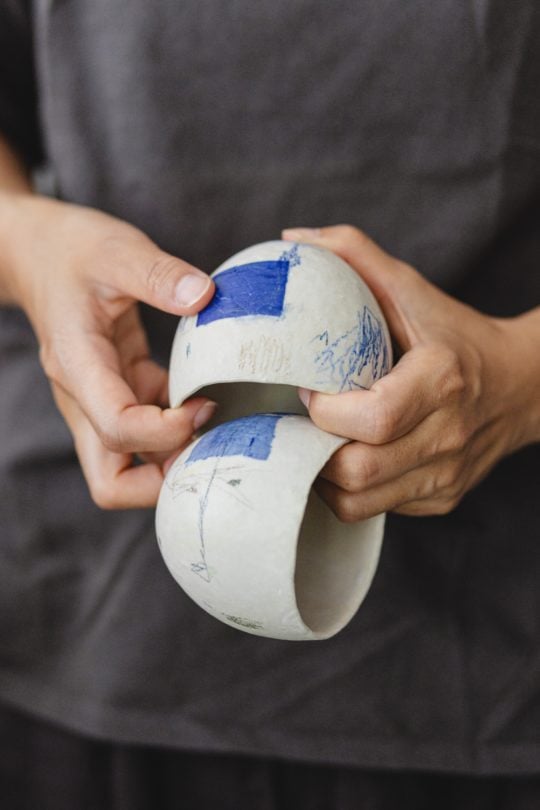
This sensitivity to surfaces extends beyond furniture. Their ceramicware collection of mugs (or “egg cups” as they call them because of their oval shape) was made with the same design approach. The process was equally intuitive, blending geometric shapes with, of course, their daughter’s input.
“The designs on the cups are inspired by watching Muyi draw. There’s a certain joy and freedom in how she does it, and we wanted to capture that feeling. We approached it as if we were playing like children, there’s no fixed image or strict design. Every piece is different, and every piece is playful,” Ying explains.
For the cups and some other pieces they used a layering technique: placing a piece of paper on the surface, then brushing porcelain over it so the paper’s texture remains after firing.
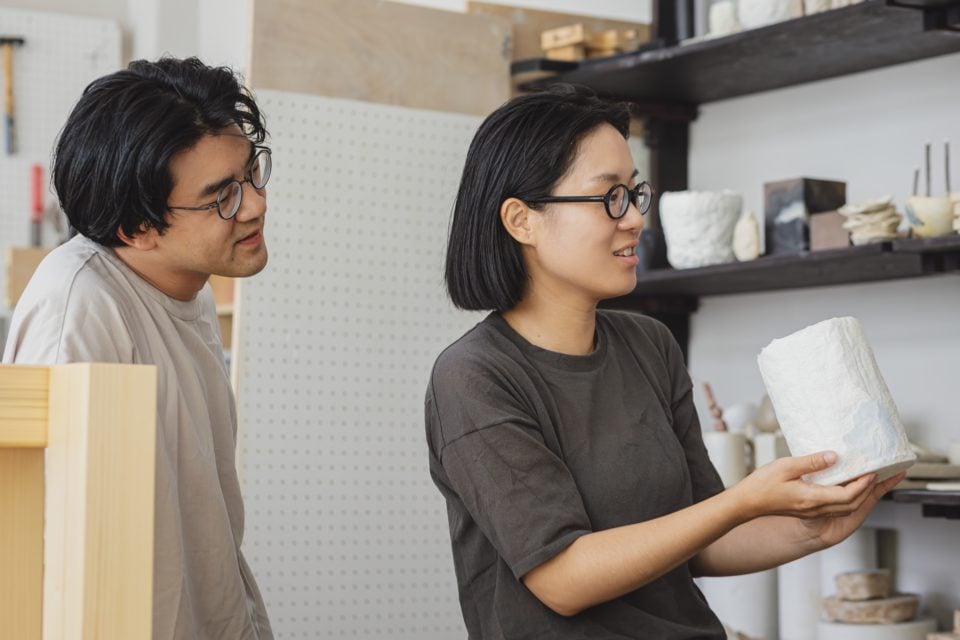
“This piece actually began as a test project that started with Washi paper,” Ying says, reaching for a cylinder-shaped white vase.
“When fired, the paper burns away and sometimes causes the surface to curve. That shape is something you can’t really control, it takes its own path. And that unpredictability makes it even more special.”
Right now, they are experimenting with different papers and clays. “Let’s see where controlling—or not controlling—the process might lead us,” Ying says, smiling.
Their explorative collections are appreciated not only by their daughter but by their clients as well. Eight years after opening the studio, the duo are grateful for the network they’ve established so far. Clients who tend to share their understated aesthetic and often become friends, sending photos of how they use the pieces. Commissions come with full creative trust, something the artists value deeply. Exhibitions have become more selective: “We’re not chasing constant exposure anymore. We’d rather slow down, enjoy the process, and create work we love,” they say.
As for the future, they hope to move past ceramic tableware toward bigger scale projects. Their ambitions include larger commissions, installations, and interior design—always with their distinctive language intact. For now, the two are happy working at a sustainable rhythm, resisting the industry’s hamster wheel, and holding onto the wildness that first defined their practice.
As they put it, “Go back to the wildness” isn’t just a nostalgic nod to their student days. It’s a way of working—hands-on, fearless, and free—that still guides Yellow Nose Studio today.
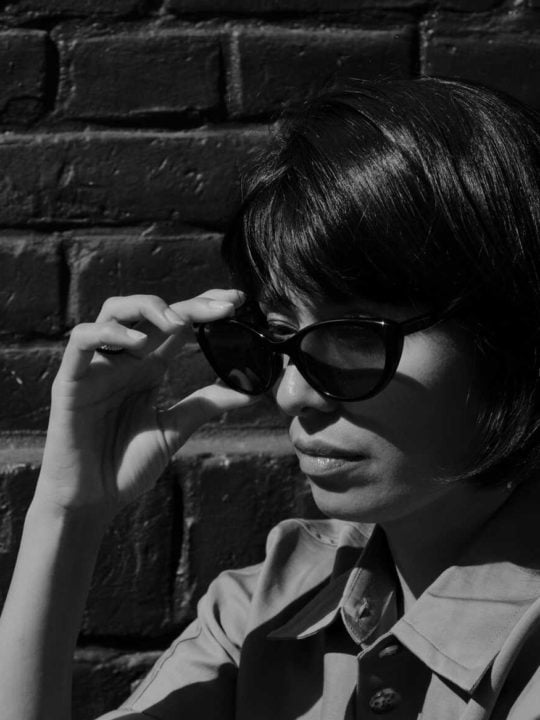
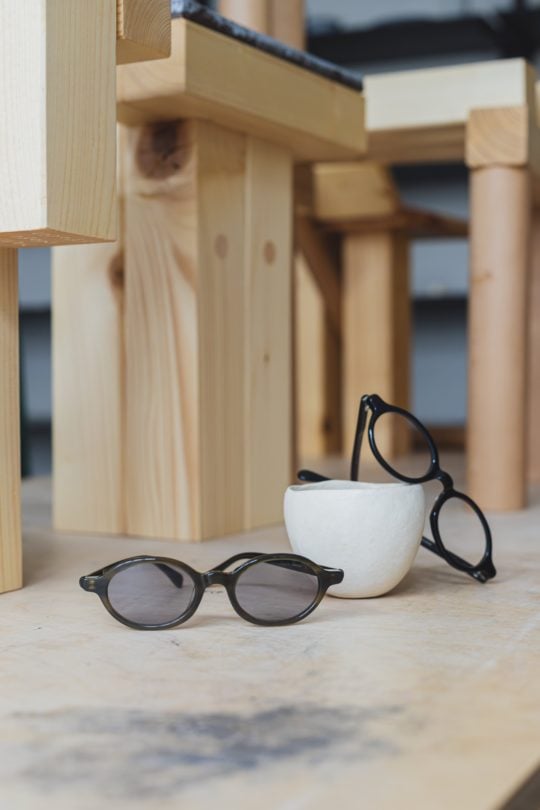
Kai wears Nell in antique silver and Ying wears Micro in black.